The AI 5-Layer Cake: A Better ASX Watchlist For The Infrastructure Boom
AI infrastructure has become one of the clearest market themes in the US. The easy headline is chips, but the more useful thesis is broader: if AI models keep getting more capable, the demand spreads into memory, power, data centres, networks, software, and the physical work needed to keep the system online.
Leopold Aschenbrenner framed the pace of progress as roughly 0.5 orders of magnitude a year, or about two orders of magnitude every four years. Whether that exact path holds or not, the direction is hard to ignore. As a software engineer, I can feel the jump in capability from the GPT-4 era to newer frontier models. It is not magic, but it is enough to make the infrastructure question worth researching seriously.
That is why NVIDIA's five-layer cake is useful. It turns the AI boom from a single-stock story into a research map for the full stack:
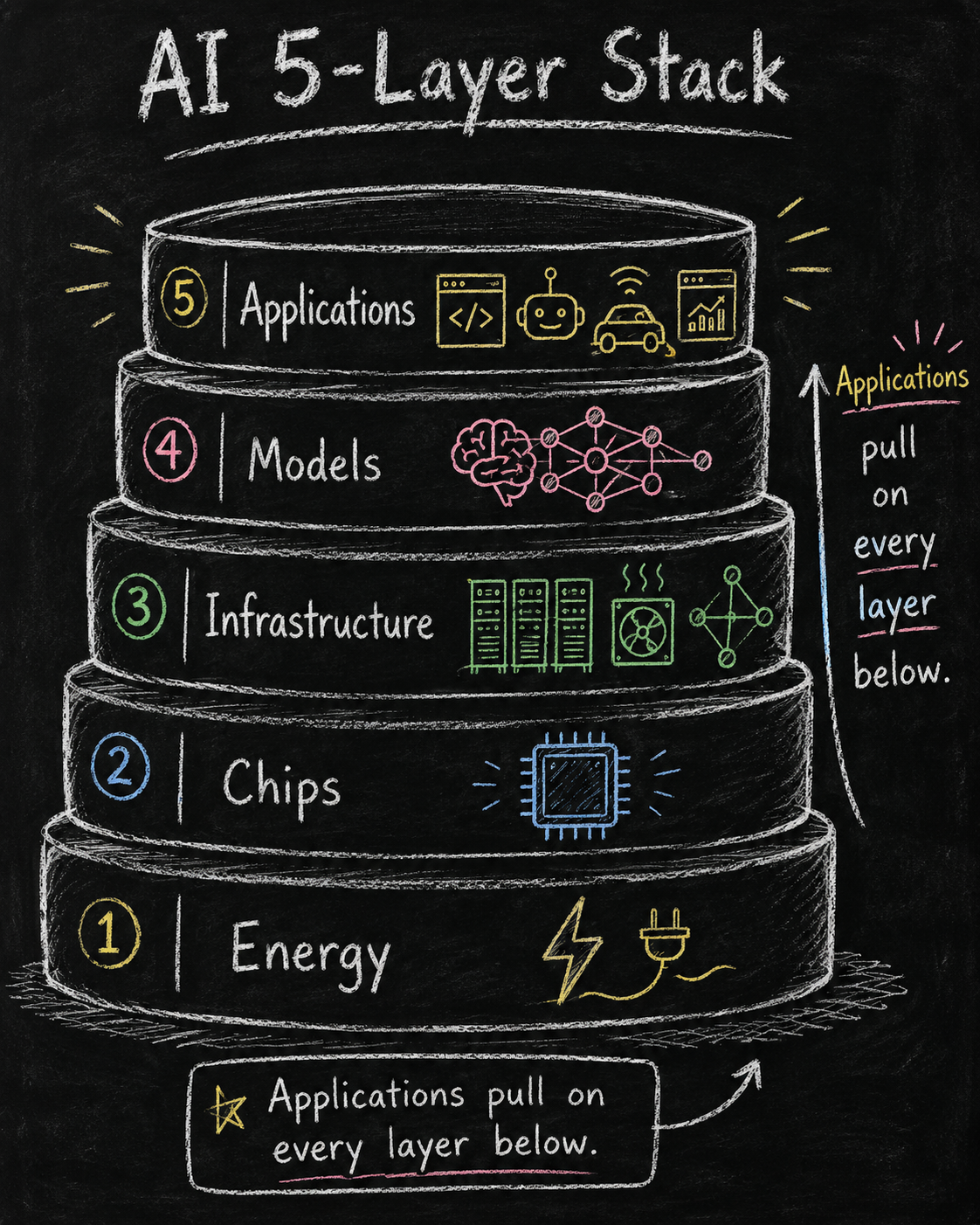
In the US, there are obvious names across the stack like $MU, $AMD, $MSFT, $META, and $GOOGL. The ASX version is less direct, but still researchable if we focus on the layers Australia can realistically touch.
The ASX does not have a clean NVIDIA. It also does not have a local frontier model lab. The more relevant local theme appears to be energy, grid services, data centre infrastructure, and high-quality application software.
Why This Matters
The International Energy Agency estimates data centres used about 415 TWh of electricity in 2024 and could reach roughly 945 TWh by 2030 in its base case.
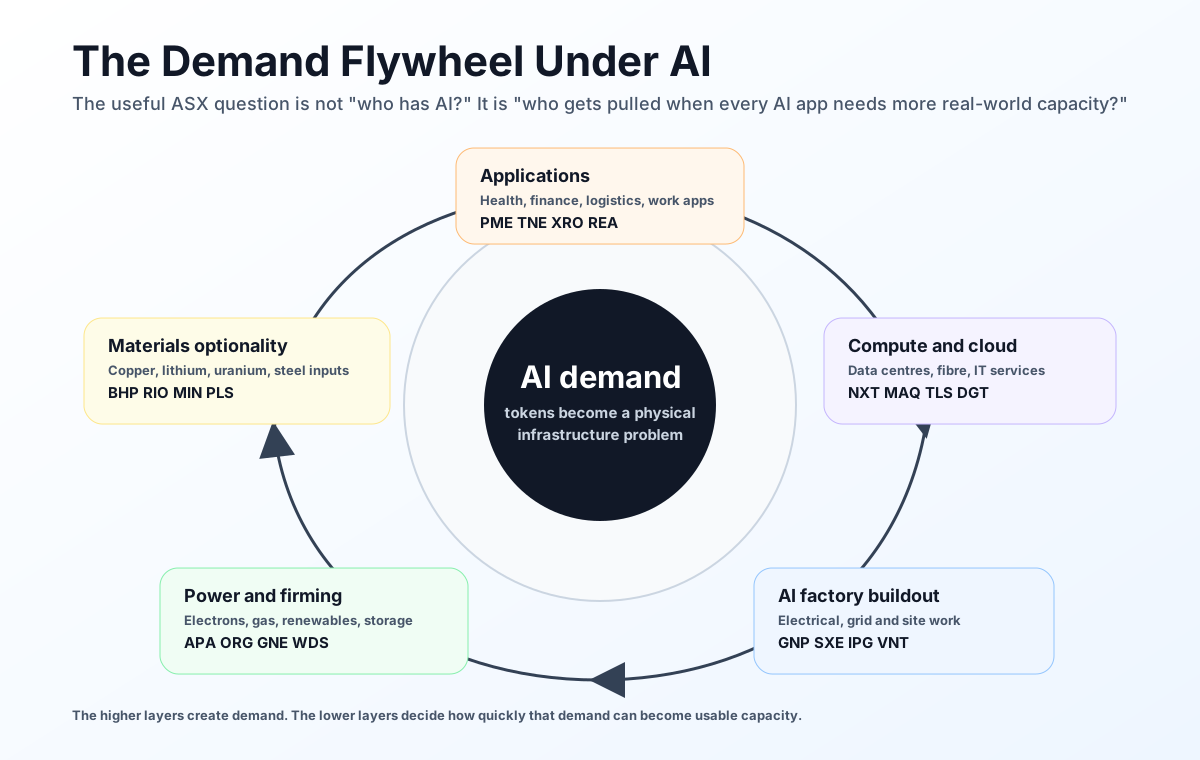
The important point is not the global number. It is the local bottleneck. Data centres need power, cooling, fibre, grid connections, backup supply, switchgear, permits, construction labour, and maintenance. Those constraints do not scale like software.
The ASX Layer Map
These are examples of ASX-listed companies that appear to sit near each layer of the theme. The list is not a recommendation list, and inclusion here does not mean a company is attractive at today's price.
| Layer | ASX examples | Notes |
|---|---|---|
| Energy | $APA.AX, $ORG.AX, $GNE.AX, $CEN.AX, $SXE.AX | Core power, grid, generation, and firming exposure. |
| Chips | $DTL.AX, $DDR.AX, $CDA.AX | Mostly proxies. The real chip layer is offshore. |
| Infrastructure | $TLS.AX, $GNP.AX, $SXE.AX, $IPG.AX, $VNT.AX, $DOW.AX | The strongest ASX layer: fibre, electrical systems, maintenance, grid services, and buildout work. |
| Data centres | $GMG.AX, $MAQ.AX, $NXT.AX | Direct or adjacent exposure to data centre property, cloud, and hosting. |
| Models/apps | $PME.AX, $TNE.AX, $XRO.AX, $REA.AX, $CAR.AX, $CPU.AX | Not model labs. These are domain software and workflow businesses where AI can improve product value. |
| Materials optionality | $BHP.AX, $RIO.AX, $MIN.AX | Useful, but not the main cake. Broad miners fit the physical buildout better than pure lithium names. |
Where Lithium Does Not Fit
$PLS.AX and $LTR.AX do not really belong in the core AI infrastructure thesis. They are better understood through electrification, decarbonisation, batteries, and electric vehicles.
That does not make lithium irrelevant as a separate macro theme. It just means the link is indirect. A data centre needing more electricity creates a cleaner research signal for grid connections, energy infrastructure, electrical contractors, fibre, and data centre operators than for lithium miners.
For the physical AI buildout, broader materials names such as $BHP.AX, $RIO.AX, and $MIN.AX sit closer to the theme because copper, aluminium, iron ore, and industrial inputs touch more of the stack.
So $PLS.AX and $LTR.AX can stay on a separate electrification watchlist. They should not be forced into the AI cake.
The Theme Map
One neutral way to organise the theme is by grouping examples around the physical and software layers:
| Theme area | ASX examples |
|---|---|
| Energy foundation | $APA.AX, $ORG.AX, $GNE.AX, $CEN.AX |
| Infrastructure core | $TLS.AX, $GNP.AX, $SXE.AX, $IPG.AX, $VNT.AX, $DOW.AX, $IFT.AX |
| Data centre watchlist | $GMG.AX, $MAQ.AX, $NXT.AX |
| Application layer | $PME.AX, $TNE.AX, $XRO.AX, $REA.AX, $CAR.AX |
| Materials optionality | $BHP.AX, $RIO.AX, $MIN.AX |
This is a research taxonomy, not a portfolio model. Each company still needs separate work on valuation, balance-sheet risk, execution risk, liquidity, and whether the theme is already priced in.
Screening Cautions
- Be careful with tiny "AI" names that lack a durable business model.
- Be careful with battery or hydrogen microcaps that depend on perfect capital markets.
- Be careful with local chip stories that are mostly experiments.
- Be careful when a company only fits the theme because of a slide deck.
Bottom Line
For ASX research, the most relevant parts of the AI cake are not necessarily chips or frontier models. The local market has more obvious links to power, grid services, data centre infrastructure, and quality vertical applications.
Lithium is better treated as an electrification and decarbonisation theme, not the core AI-infrastructure thesis. A cleaner research frame is to ask which listed companies help power, build, connect, or operate the AI infrastructure boom.
This article is general market commentary and educational research, not financial advice or a recommendation to buy, sell, or hold any security.
Sources: NVIDIA's five-layer cake, Leopold Aschenbrenner's Situational Awareness, and the IEA's Energy demand from AI. Ticker examples were screened against Marketpal production profile data on May 9, 2026.